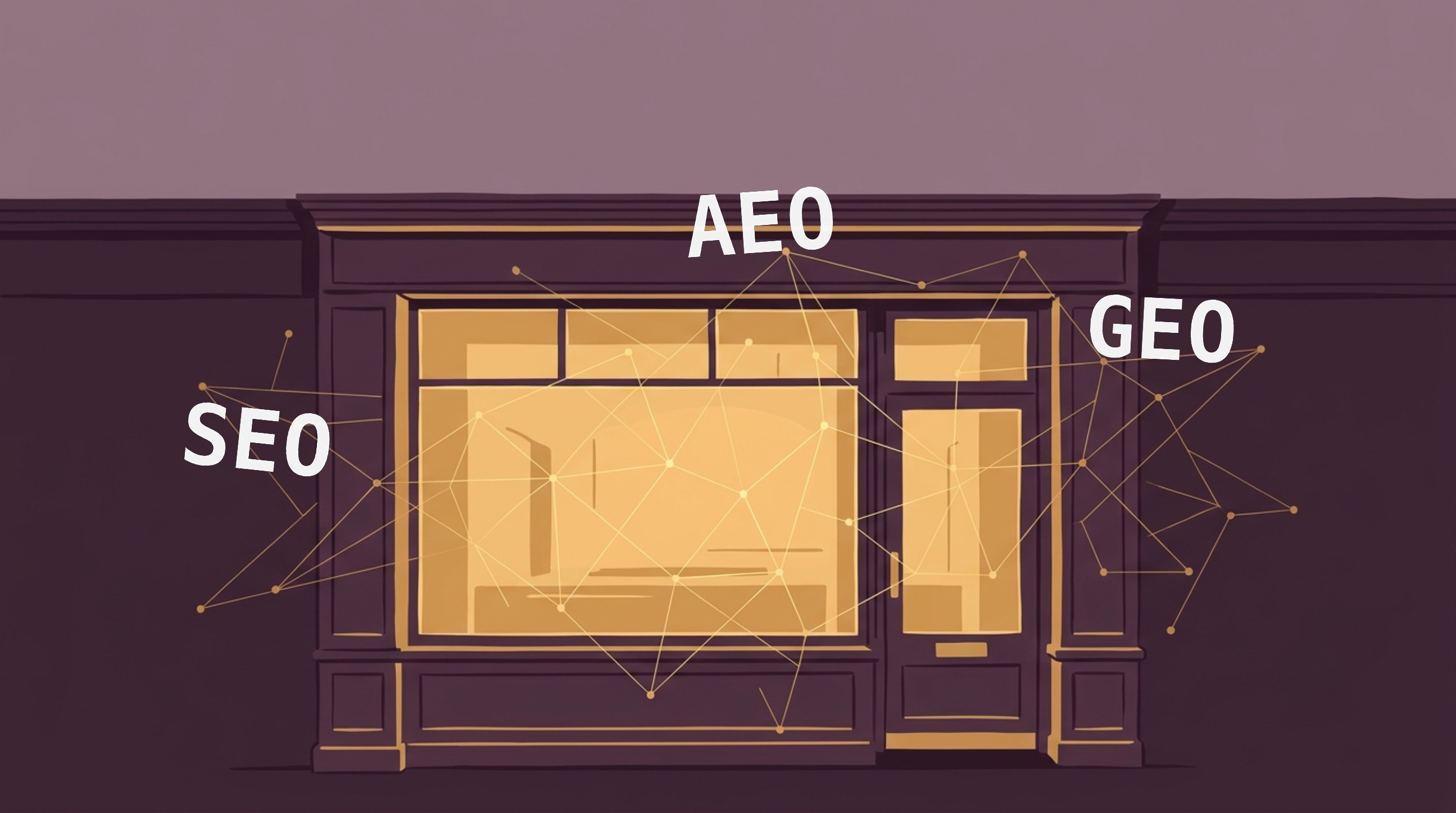
Your Website Isn't Enough Anymore
(And It's Not Your Fault)
Short answer: having a website tells people about your business. It doesn't automatically tell the systems people now use to find businesses -- and those are two very different audiences.
Here's what that actually means, and what we did about it for our own shop.
The part nobody explains to small business owners
When someone visits your website, they can see everything: your logo, your photos, your hours, your story. It's all right there.
But a website isn't just read by people anymore. It's also read by machines — search engines, and increasingly, AI tools like ChatGPT, Perplexity, and Google's AI answers. And here's the catch: those machines don't "see" your site the way a person does. They don't recognize a phone number in your footer as your phone number. They don't know a photo of a t-shirt is a product you sell. Unless you tell them, in a format they're built to read, none of it counts.
That invisible layer is called schema markup — structured data sitting quietly in your site's code, basically a form your website fills out so machines don't have to guess. Name, hours, service area, reviews, what you actually sell. Without it, a human visitor sees a complete business. An AI tool sees… not much of anything.
Why this matters more than it used to
A few years ago, this mostly affected where you ranked on a Google results page. Now it affects something bigger: whether AI tools recommend you at all.
When someone asks ChatGPT or Perplexity "who does custom shirts near me," that tool isn't crawling the whole internet in real time. It's pulling from structured, trustworthy sources — and if your business isn't presenting itself in a way those tools can actually parse, you're invisible in that answer, even if you're the best shop in town.
What this looked like in practice
We recently went through this exact process for one of our own shops, Tiffany's Touches. A few things we found, that are honestly true for most small businesses:
- The homepage had zero structured data. A human could tell it was a real, established local business. A search engine or AI tool couldn't confirm any of that on its own.
- Real customer reviews existed but weren't "readable." Five genuine five-star reviews were sitting on the site as plain text — invisible as trust signals to anything but a human reader.
- No Google Business Profile existed at all. Which meant zero presence in the single most-cited local data source AI answer tools pull from.
- Traffic sources told the real story. Every visitor was arriving from a link someone posted — Facebook, direct shares. Nobody was finding the site through search or an AI tool, because there was nothing there for those systems to find.
None of the fixes were complicated. They were just invisible — the kind of thing you'd never notice unless you went looking for it specifically.
The short version
If your business only exists for human eyes, you're only half-visible. The other half — search engines, AI tools, the increasingly common way people actually ask "who does this near me" — needs its own version of your business card, written in a format machines can trust.
Most small businesses have never heard this needs doing, let alone had someone actually do it.
We handle this as part of the web work we do at Belle Creata — schema, structured data, Google Business Profile setup, the whole layer most sites are missing. If your business could use the same pass we just gave our own shop, reach out.
Ask about it →